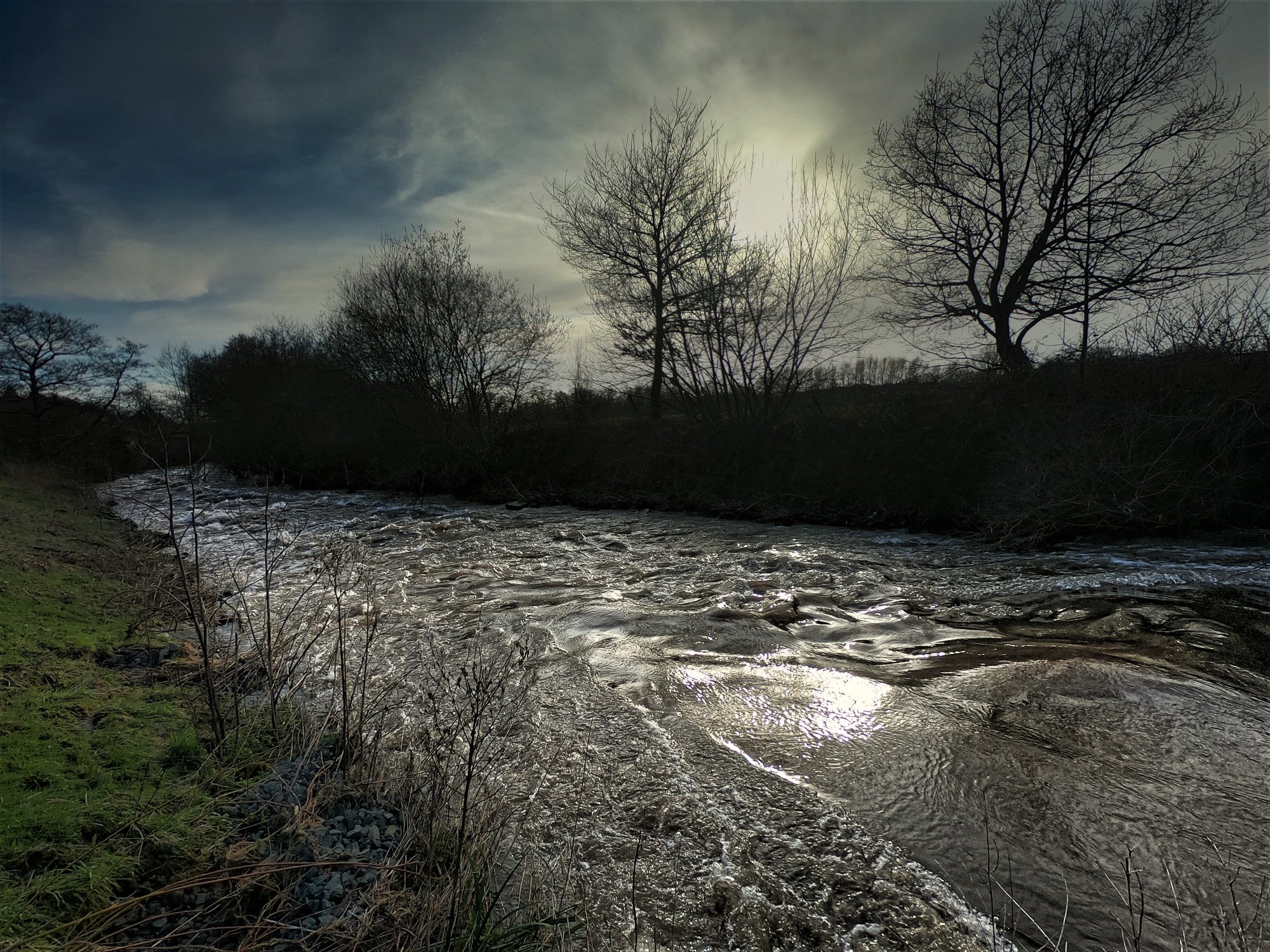
If Wilden Marsh has a pulse, then the River Stour is it.
I feel that pulse on the mornings I stand on the South Pasture riverbank, looking out over the Stour toward the West Side. The reedbeds and tussocks seem to vibrate; mist drifts slowly across the water, and for a moment it feels like a self‑contained world. It isn’t, of course. Everything here is borrowed, delivered, or carried away by the Stour, including vast quantities of rubbish travelling down from Midlands towns, beginning a long journey that may end in the seas and oceans, and eventually on distant shores. What arrives here has already passed through many hands, bins, drains, and decisions.
The marsh exists because the river made it.
The Stour is not a grand river, it’s a wriggling, worm‑like force of nature. Rising gently in the Clent Hills, it gathers speed and volume as it slips through farmland, towns, and old industrial ground before meeting the River Severn at Stourport. By the time it reaches Wilden, it has already done much of its work, picking up, redistributing, and discarding along its twenty‑five‑mile length. One of its largest deliveries is made here. The previous big flood, a month or so ago, washed away most of the rubbish deposited by an earlier flooding episode. Last week’s minor flood has already replaced it with another scatter of plastic debris. There is no let‑up, because nothing upstream has meaningfully changed.
For centuries, the Stour was a working river. Its flow turning mill wheels, powered early industry, washed wool, moved waste, and carried runoff from fields and roads. People put it to work. The Stour was used, managed, straightened in places and restrained in others. Wilden Marsh is, in part, the result of a long relationship between water, labour, and later industry.
The marsh is always ready for the sudden rush of water that increasingly overwhelms it. When the Stour rises, the land holds and stores the turbid flow. Seasonal flooding is not a problem here; it is part of the process that has shaped this landscape over aeons. What has changed is the speed and force with which water now arrives, aided by hard surfaces, drains, and a belief that floodwater should be someone else’s problem. Each overflow spreads fine silt and nutrients; each retreat leaves the ground slightly richer, slightly more alive. Thick grasses and rushes stand firm in newly softened ground, and lingering water after heavy rain allows the river to serve the land and the animals that depend upon it. The marsh absorbs, slows, filters, and disperses floodwater as it always has, taking on work that is rarely acknowledged.
Wildlife reads the signals of strengthening storms and rising flows and responds instinctively. That is not to say there is never panic. When the ground is this soft, snipe arrive. Herons and egrets patrol the overflow channels for rich pickings and minerals. Fish fry find shelter in the flooded margins. Insects breed explosively as the water recedes, spreading out into the wider valley. The marsh does not merely support life here; it drives it.
Everywhere are signs of past attempts to control the water: old ditches, banks, and straightened cuts that once had a purpose but have since silted up because they were not the best solution. None of them truly won. The river still slows here. The marsh still spreads water out, takes the edge off floods, and holds and filters what would otherwise surge downstream. In doing so, it protects places beyond its boundaries—places that benefit from the protection without having to see the cost.
This is something we are only just beginning to relearn: that a marsh is not wasted ground, and that a river allowed to move more slowly creates resilience rather than disorder. For a long time we treated wetlands as expendable, and then expressed surprise when floods became emergencies elsewhere. Wilden Marsh is not untidy; it is functional in ways that are easy to overlook. Fallen trunks and trapped branches create slack water, encouraging fish to linger and move upstream more easily. Ponds and pools are restocked naturally by floodwater, allowing small fry to grow quickly and feed the animals that depend on them.
When I walk here, I am walking on reclaimed land that is constantly changing. Not quickly, but always adapting to shifting conditions. The Stour leads; the marsh responds.
Take away the River Stour, and this place would lose its reason for being. With it, Wilden Marsh continues to breathe and to strengthen, reliably compensating for a world that has forgotten how to make room for water.


Leave a Reply